
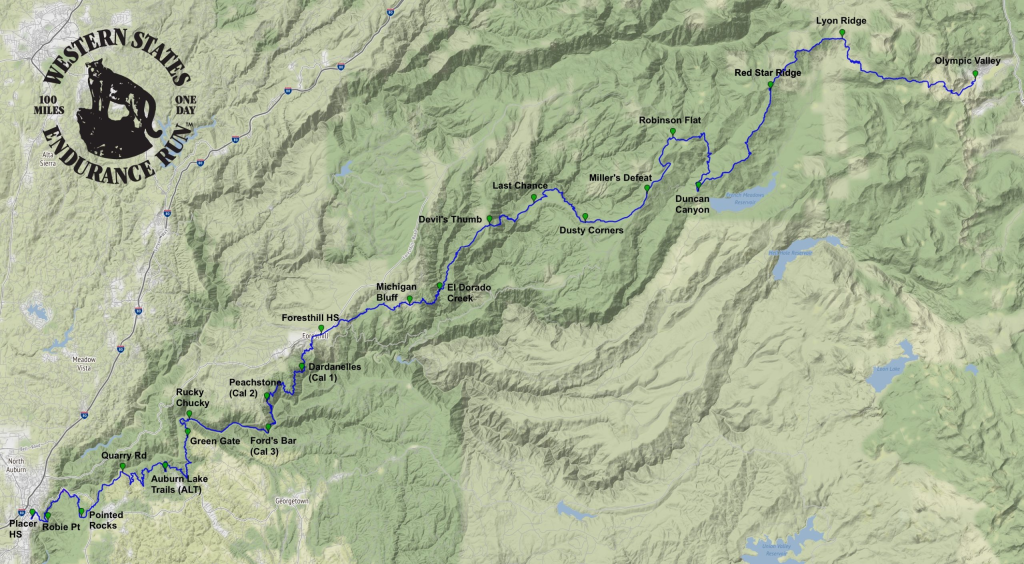
Western States Endurance Trail from Olympic Valley (Palasades Tahoe) to Auburn, California. The stories on this page are based on real events that occurred along this historic 100- mile course.
The following stories are true events experienced by Kim and me while providing amateur radio communications support for events such as the Western States 100 and the Tevis Cup. They illustrate the unexpected situations that can arise and the important role amateur radio volunteers play behind the scenes.
For Decades, amateur radio volunteers have supported events such as the Western States 100, Tevis Cup, Davis Double Century and many other public service events. Most events are routine, but every so often, radio operators become a critical link in helping someone in need. These are some of those stories.
Runner in Trouble
One year during the Western States 100 mile run a runner reached the 10.3 mile point from the start of the race. The check point is called Lyon Ridge at 7,000 feet.
The runner was complaining about chest pain. The medical staff at the check point had the runner sit down. The runner insisted on continuing the run. He got up and started to head out. The chest pain immediately came back. Net control was notified. The decision was made to dispatch the CHP helicopter.
One of our experienced amateur radio operators was able to communicate directly with the CHP helicopter pilot on its assigned frequency. The amateur radio operator gave the pilot the exact GPS location and found a suitable place for the helicopter to land close by. Our ham friend guided the pilot via his radio to where the check point was located. The runner was loaded onboard the helicopter and was flown to a hospital.
I was working the Robinson Flat check point as the radio operator. Net control asked me to try to locate the runner’s wife who was at my check point waiting for her husband. I found the runner’s wife. I was the one who had to tell her, her husband had been taken to the hospital via the CHP helicopter. The first words out of the runner’s wife was how are we going to afford this? We are from Canada! I gave the runner’s wife directions to the hospital and she got in her vehicle and drove off.
It turns out the runner was having a heart attack and ended up with stents in his heart and made a recovery. This story was a reason for having amateur radio operators at the check points during the run! The runners life was saved thanks to amateur radio.
This incident is one of the many reasons amatreur radio operators continue to volunteer at endurance events. When normal communications are limited, trained radio operators can provide the vital link that helps and saves lives!
Locked Gate
Kim and I were the roving repair team during last year’s Tevis Cup. We carried tools and equipment to help anyone having vehicle or horse trailer problems . Net control called us and let us know there was a locked gate and the radio operator and check point crew were unable to get access to their assigned check point. No one told us exactly where the gate was. We drove around and were not finding the gate. We drove around for a while. Looking. Then we found a gate open that looked like that was the route we needed to take, We continued down the road for a while and sure enough we came to the locked gate. We had a key to the locked gate. I wont say how we obtained the key. I will only say we had a key that worked on many gates and will leave it at that. Then the other issue with the locked gate was it was a very long reach to get to the lock. Kim had brought his extra long needle nose pliers. He held the key tightly and was able to get the key into the pad lock and turn the key. The pad lock released and we opened the gate. We left the gate open and the radio operator and check point crew were able to get to their assigned check point just in time for the first rider to show up! Kim and I continued helping with the Tevis Cup!
Horse went the wrong way
One year during the Tevis Cup ride. There was a man from Japan that rented a horse that had qualified to ride the Tevis Cup. The man got to the place on the Westen States trail where the trail required crossing the American River. The Tevis Cup committee always made sure the river flow was mitigated down so horses could cross the river without issue. The man from Japan did not know the route very well. Unknown to the man from Japan, the horse knew it was close to the ranch and barn where it lived. The horse crossed the river and continued on the trail and then took a trail that went right to the horse’s home. That was the end of the ride for the man from Japan.
Medical Care Denied
On one of the Tevis rides I was working at the Robinson Flat check point as the radio operator. Robinson Flat is one of the busiest check points for Tevis. It is a mandatory vet check and 1 hour rest for the horses. The horses must be un-saddled and their heart rate and respiration rate has to be under predetermined rates before they are allowed to continue on to the vet check. The riders are smart about not working their horses hard the last mile or so before getting to Robinson Flat. The horses are also trotted up and back in a lane while the vets look for lameness or other issues with the horse. It is amazing how well the horses are cared about. The vet check area uses veterinarians from UCDavis vet school and vet students. There are 5-gallon IV bags hanging in pine trees in the event horses require hydration. Once the vets determine the horse requires an IV they are pulled from the ride and trailered out. I was busy on the radio all day. A female rider came in with a big deep cut on her cheek where a tree brach had caught her in the face. The medics told her she needed to go and get medical attention and it was beyond their ability to treat her. The next thing I saw was the rider disappear in the bushes with one of the vets. I didn’t see the treatment itself, but when she returned she had stitches. The rider was told she would end up with a big scar if she did not leave for medical treatment at a facility. The rider was one of the top contenders and did not care how she looked cosmetically. Her horse passed the veterinary check and she saddled up and rode on.
Vehicle could not move
I worked the Robinson Flat check point for a number of years for the Tevis Cup. Robinson Flat is so busy there is no room to park vehicles. Each rider has a support crews that travel from checkpoint to checkpoint meeting there rider throughout the event. There is a well organized method to manage the crew vehicles. The crews are allowed to bing their vehicles to Robinson Flat and have ten minutes to unload their supplies for their rider. The vehicles are in a big line and make a circle to drop off the crew . Then the vehicles have to go down a road to get parked. Then there is a bus that brings people back from the vehicle parking area. The bus makes several trips to Robinson Flat. A woman in a van parked and dropped off the crew and supplies. The woman went to get back in her van and she had locked her keys in her van. The driver was panicked because she knew she was holding the flow of traffic up. I happened to be right where her van was. She asked me what to do. I told her she was going to have to break a window and get her keys. I told her to pick a small window it would be less expensive to get a small window replaced. The woman did not hesitate! She picked up a rock, shattered the small vent window, unlocked the van, retrieved her keys and drove around the circle. I was impressed by her composure and how quickly she broke the widow. I gave her a hug and thanked her. She saved the check point from a major issue!
The Stubborn Mustang and Rider
I was working as the amateur radio person at Robinson Flat, as I had done for many years during the Tevis Cup. That year, a young woman riding a Mustang arrived at the check point. The horse had developed a medical issue. It wasn’t life-threatening, but the veterinarians determined it could not continue and would have to be trailered out.
Once all the riders have left a check point, the amateur radio operators are the last volunteer to leave. We have to wait until all the riders are accounted for and the check point is officially closed. The young rider was asked to help load her horse into the trailer. She replied the horse was not hers and that she had no intention of helping. She walked away, leaving the volunteers stunned. There were several experienced horse people still at the checkpoint, and I had already packed up most of my radio equipment. Everyone tried leading the Mustang into the trailer. They tried different approaches, tempting it with carrots, hay, and anything else they thought might encourage it. The Mustang refused every attempt. After three hours of patient effort, they finally succeeded in getting the horse into the trailer. Only then did the trailer leave, and Net Control gave permission to call Robinson Flat closed and head home.
It was a much later night than I expected-all because of one stubborn Mustang and a rider who refused to help.